Conservatory Program
Serious Art Education That Fits a Busy Life
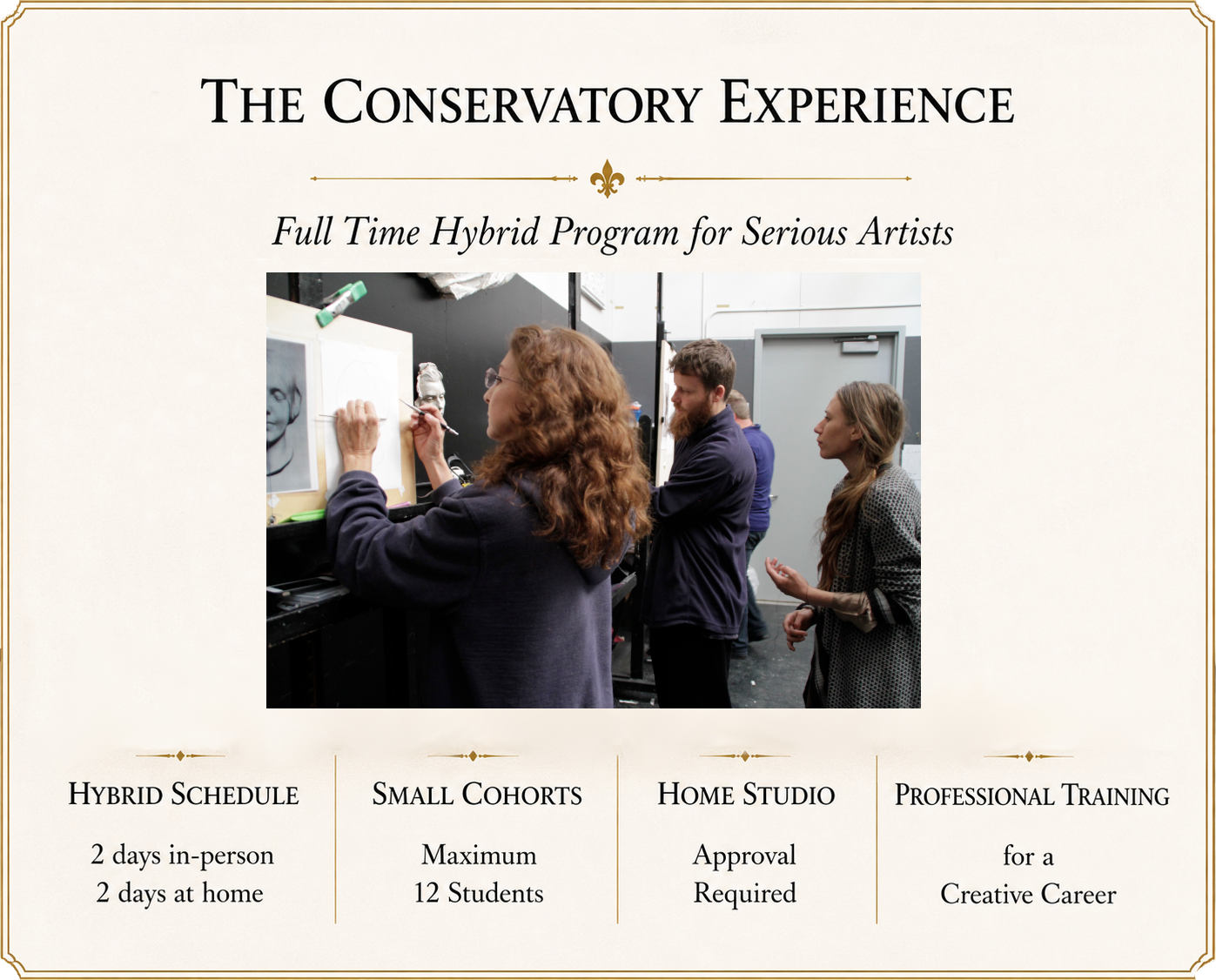
The Conservatory Program at The Neoteric Arts is a nine-month hybrid fine art education experience combining in-person studio instruction, guided home study, and online mentorship. Admission is limited to 12 students each year through an application and approval process to ensure individualized instruction and a focused learning environment.
Built around a deliberate progression that develops artists from careful observers into confident creators, rather than rushing students toward finished artwork, our curriculum first trains the eye, then the mind, and finally the expressive capacity of the artist through three interconnected Branches of Mastery: Foundation, Structure, and Expression. Rooted in the timeless methods of the Old Masters while remaining relevant to contemporary artists, students systematically build technical skill, visual intelligence, creative confidence, and an authentic artistic voice through drawing, painting, sculpture, anatomy, design, and visual communication. The result is a deeper understanding of not only how to create art, but why great works communicate beauty, emotion, and meaning.
Built around a deliberate progression that develops artists from careful observers into confident creators, rather than rushing students toward finished artwork, our curriculum first trains the eye, then the mind, and finally the expressive capacity of the artist through three interconnected Branches of Mastery: Foundation, Structure, and Expression. Rooted in the timeless methods of the Old Masters while remaining relevant to contemporary artists, students systematically build technical skill, visual intelligence, creative confidence, and an authentic artistic voice through drawing, painting, sculpture, anatomy, design, and visual communication. The result is a deeper understanding of not only how to create art, but why great works communicate beauty, emotion, and meaning.
Weekly Conservatory Rhythm
A consistent weekly rhythm balances observation, analysis, practice, reflection, and community.
| Day | Focus |
|---|---|
| Monday | Studio Drawing & Painting Studies |
| Tuesday | Independent Anatomy Study |
| Wednesday | Live Model Session |
| Thursday | Perspective, Geometry & Structural Study |
| Friday | Online Critique, Review & Weekly Showcase |
This schedule allows students to continually build skills while receiving regular feedback and participating in a supportive artistic community.
Small Cohorts. Exceptional Growth.
At The Neoteric Arts Conservatory, we intentionally limit each Conservatory cohort to a maximum of 12 students. This small class size creates an immersive learning environment where every student receives meaningful individual attention, personalized critiques, and direct mentorship throughout the program. Rather than becoming one face in a crowded classroom, students benefit from consistent interaction with instructors who understand their strengths, challenges, and artistic goals. Small cohorts also foster a collaborative studio culture where artists learn from one another, build lasting relationships, and grow together through shared critiques, discussions, and encouragement. This balance of individualized instruction and supportive community allows every student to develop technical mastery, creative confidence, and a stronger artistic voice at a pace that simply isn’t possible in larger classes.
A Dedicated Home Studio
Success in the Conservatory Program requires consistent practice beyond the classroom. Because students spend two days each week working independently, every applicant must have access to a dedicated home studio or workspace that supports focused artistic study. This space does not need to be large or elaborate, but it must provide adequate lighting, sufficient room to work safely, and the ability to set up and leave projects in progress between sessions. Before acceptance into the program, each student’s home studio will be reviewed and approved to ensure it meets the minimum requirements for productive learning. A well-prepared workspace allows students to maintain momentum between in-person classes, complete assignments successfully, and develop the disciplined studio habits essential for artistic mastery.
Branch I — Foundation
Learning to See
Every accomplished artist begins by learning how to truly observe. The Foundation Branch develops observational accuracy, visual discipline, and the ability to understand what is actually being seen rather than what the mind assumes.
Students begin with charcoal and graphite, studying value, proportion, perspective, and form through direct observation. Through still life studies, master copies, and classical cast drawings, students learn to slow down, analyze light and shadow, and understand the underlying architecture of form.
Areas of Study
- Gesture Drawing
- Sight-Size Method
- Comparative Measurement
- Plumb Line Techniques
- Mirror Corrections
- Basic Perspective
- Value & Light Logic
- Charcoal Drawing
- Graphite Drawing
- Master Copies
- Cast Copies
- Still Life Studies
- Studio Practices & Materials
Geometry & Form
Students are introduced to the Platonic Solids as the foundation of visual structure. Special emphasis is placed on the sphere, helping students understand volume, light, and three-dimensional form. This “drawing in the round” establishes the structural thinking required for future anatomy, painting, and sculpture.
Learning Outcome
By the completion of Branch I, students can accurately observe, measure, simplify, and represent the visible world with confidence.
Branch II — Structure
Understanding Form
Once students learn to observe accurately, they begin understanding why forms behave the way they do. Branch II moves beyond recording appearances toward constructing images with purpose and intention.
Painting, clay modeling, anatomy, design, perspective, and composition are introduced as interconnected disciplines that work together to create compelling visual communication.
Areas of Study
- Limited Palette Painting
- Grisaille Painting
- Monochromatic Painting
- Cast Drawing
- Cast Painting
- Clay Modeling
- Structural Drawing
- Figure Construction
- Still Life Design
- Intermediate Perspective
- Two-Point Perspective
- Three-Point Perspective
Geometry & Design
Students explore the principles that have guided great artists for centuries, including:
- The Golden Section
- Dynamic Symmetry
- Harmonic Relationships
- Visual Rhythm
- Balance
- Movement
- The Relationship Between Form and Meaning
Through careful analysis of masterworks, students discover why certain compositions communicate harmony, strength, tension, beauty, or emotion.
Anatomy
Anatomy is integrated throughout the entire nine-month program, becoming increasingly sophisticated as students advance. Using clay as a learning tool, students construct the skull, rib cage, pelvis, and major skeletal structures to understand how the human figure is built from the inside outward.
Learning Outcome
Students develop structural thinking, stronger compositional awareness, and a deeper understanding of how visual elements influence perception and meaning.
Branch III — Expression
Personal Voice & Mastery
The final branch brings together observation and structure to develop artistic expression. Technical skill becomes a vehicle for communication, storytelling, and personal vision.
Students work with increasingly advanced subjects while developing an individual portfolio that reflects both mastery and originality.
Areas of Study
- Expanded Color Palette
- Advanced Painting
- Figure Painting
- Portrait Painting
- Portrait Sculpture
- Head Construction
- Advanced Anatomy
- Personal Projects
- Portfolio Development
- Exhibition Preparation
Capstone Project
Each student completes a significant body of work that demonstrates the successful integration of observation, structural understanding, anatomy, design principles, and personal artistic expression.
Learning Outcome
Graduates leave with:
- A professional-quality portfolio
- A mature artistic voice
- Confidence for independent study
- Preparation for professional artistic practice
Anatomy & Figure Study
Anatomy is not confined to a single course. Throughout every branch of the Conservatory, students participate in ongoing anatomy and figure study that continually reinforces drawing, painting, sculpture, and design. This continuous thread helps students build a complete understanding of the human form while strengthening every area of artistic practice.
The Conservatory Experience
The Neoteric Arts Conservatory combines rigorous classical training with contemporary flexibility. Students receive structured instruction, ongoing mentorship, live critiques, independent study assignments, and progressive skill development within a curriculum that intentionally builds from one discipline to the next.
Every lesson, assignment, and critique supports a larger educational philosophy—developing artists who possess both exceptional technical ability and the confidence to create meaningful work.
The Goal
The purpose of The Neoteric Arts Conservatory is not simply to teach students how to make art—it is to cultivate artists who learn to see clearly, think structurally, and express meaningfully. Through a carefully sequenced curriculum rooted in the traditions of the Old Masters and enriched with contemporary relevance, students develop the skills, discipline, and artistic voice necessary for a lifetime of creative growth.